
I’ve started to notice something while studying supply chains: reading theory without real cases feels incomplete.
You can memorize frameworks. You can recite definitions. You can solve textbook problems. You can do numerical.
… and still miss how things actually work once real money and real pressure are involved.
That gap only closes when you see decisions play out inside actual businesses. When a delay, a supplier, or a design choice suddenly has consequences.
I’m especially grateful to Dr Imran Bashir Dar, Dr Babar Masood Raja, and Dr Waqar for pushing us beyond slides and into situations that forced us to think like managers, not just students.
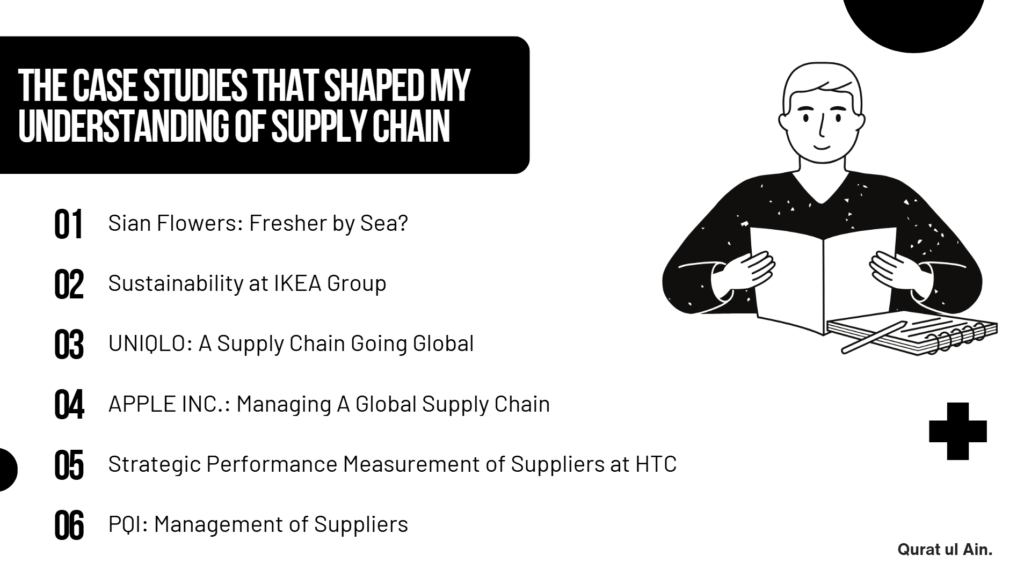
What follows is my journey through a set of cases that didn’t just explain supply chains to me, they reshaped how I see them.
The cases ahead aren’t academic exercises. They are windows into how real organizations manage risk, scale, sustainability, and speed and how small decisions in the supply chain can ripple through an entire business.
1. Sian Flowers: Fresher by Sea?
This case study lowkey flipped how I think about “fresh.”
On paper, flowers shipped by air should win but this case shows how Sian Flowers, a Kenyan rose giant, got pushed into experimenting with sea freight when COVID sent air cargo prices through the roof (we’re talking 2–3x cost spikes).
The wild part?
Roses traveling 30+ days by sea were still arriving in Europe in solid condition, sometimes with better vase life than air-shipped ones. Well, thanks goes straight to tight cold-chain control and smarter post-harvest treatments.
The real problem wasn’t quality, it was perception: buyers hear “ocean-shipped flowers” and instantly think “not fresh,” so prices drop.
That’s the core tension here was cost savings and lower carbon footprint vs. customer mindset stuck in the past.
Big takeaways I can’t unsee now:
- “Fresh” is more about process control than transport speed.
- Cheaper + greener doesn’t matter if customers don’t believe it.
- Supply chain decisions quietly reshape production strategy, not just logistics.
- Sometimes the hardest bottleneck isn’t infrastructure—it’s perception.
2. Sustainability at IKEA Group
The whole idea of this case study is: Growth without responsibility is just delayed damage.
IKEA wasn’t just planning to expand a little. They were aiming to double sales while entering emerging markets packed with new consumers.
And that’s where the case hits hard. As IKEA’s sustainability leadership openly admits,
“Worldwide economic activity, if left unchecked, is already on track to consuming 150% of planet earth’s resources… We can grow and be sustainable.”
IKEA knew that being one of the world’s largest wood buyers meant every decision echoed through forests, suppliers, and communities.
So instead of treating sustainability like a checkbox, they embedded it straight into the supply chain:
- Stricter sourcing standards
- FSC-certified wood
- Recycled materials
- Renewable energy investment
- Redesigning products to use less without raising prices.
What stuck with me from this case:
- Growth amplifies problems if the supply chain isn’t fixed first
- Sustainability only works when it’s tied to core strategy, not CSR slides
- Standards are useless unless you help suppliers actually meet them
- Being big means you don’t follow the market—you shape it
- Don’t tweak the edges, rebuild the system
Well, this case didn’t sell sustainability as idealism.
3. UNIQLO: A Supply Chain Going Global
This case stood out because of how quietly disciplined UNIQLO’s growth has been.
They didn’t chase every fashion trend, the company built scale around a tightly focused product range and a supply chain that sits at the center of its strategy.
UNIQLO works with a small group of long-term suppliers and places its own technical teams inside partner factories.
That setup gives the company strong control over quality and predictable costs. All without owning the factories themselves. It is a model built on coordination rather than ownership.
This structure worked especially well across Asia, where demand was more stable and operational efficiency mattered most. But when UNIQLO expanded into the United States and Europe, new pressure emerged.
Fashion cycles moved faster, customer preferences shifted more frequently, and the company had to test whether a system designed for precision could adapt to markets shaped by constant change.
What this case highlighted:
- A focused product range increases operational control
- Long-term supplier relationships reduce complexity
- Supply chains can drive growth, not just support it
- Global expansion exposes the limits of even strong systems
UNIQLO’s story shows that disciplined supply chains do not need to chase every trend. When built well, they create stability that lasts longer than hype.
4. APPLE INC.: Managing A Global Supply Chain
This case stood out because it shows how deliberately Apple designs its supply chain. Rather than trying to control everything, Apple focuses on the parts that directly shape customer value.
Design, core technology, and customer experience remain tightly managed inside the company.
Manufacturing is global, but it is never disconnected from Apple’s decision-making.
Apple’s retail stores play a strategic role far beyond sales. They act as live demand sensors, sending real-time signals about what customers want and how fast products are moving. That information flows straight into planning and production, allowing Apple to adjust quickly when demand shifts.
Because authority, data, and execution are closely linked, Apple can move without confusion or delay.
Suppliers are also integrated into this structure. They operate within tightly coordinated processes where timing, quality, and reliability matter more than simple cost cutting.
Apple relies less on contracts and more on system-level coordination to keep performance consistent.
What makes this model especially strong is Apple’s restraint: it does not try to optimize every part of the chain. It concentrates on the areas that have the greatest impact on the customer and protects those areas with discipline.
What this case showed me:
- Control at key points keeps complex systems manageable
- Direct customer access improves planning and responsiveness
- Speed comes from preparation and clear authority
- Deep supplier integration reduces operational risk
This case made one thing clear: Apple doesn’t win because it’s big—it’s big because it designed its supply chain to win.
5. Strategic Performance Measurement of Suppliers at HTC
This case showed me what supplier decisions look like when the pressure is real. This is what supplier management looks like when theory finally grows teeth.
HTC wasn’t just “rating” suppliers for the sake of dashboards, they were literally deciding who gets oxygen and who slowly suffocates.
Managing 1,000+ suppliers and 250–300 components per phone, HTC used a sharp scorecard (TQRDC: Technology, Quality, Response, Delivery, Cost) where quality alone carried 35% weight and cost another 30%.
Translation? Cheap but sloppy doesn’t survive.
What made this case click for me was how dynamic the system was: suppliers didn’t get fired instantly for bad grades — they got coached, monitored, re-allocated, and only dropped if they failed to improve.
Orders weren’t distributed “fairly,” they were earned.
One supplier with an A-grade could get 80% of volume, while another with shaky delivery might be pushed down to 20%.
What this case taught me:
- Measurement only matters when it affects real decisions
- Order allocation is one of the strongest signals a buyer can send
- Improvement beats replacement when capacity is tight
- Supplier relationships survive on clarity, not comfort
6. PQI: Management of Suppliers
This case study made me see supplier management at a much more granular level.
PQI is running a tiered relationship system where how close you sit to the business depends on speed, trust, and how much skin you’re willing to put in the game.
Tier 1 suppliers (think Intel, Samsung) get weekly face time because their tech literally shapes PQI’s future products.
Tier 2 suppliers? Checked twice a year, price-watched monthly.
But Tier 3 suppliers? That’s where things get real. These guys build custom parts, moulds, and housings, and one slow supplier can kill a product launch window.
PQI’s system reflected this reality. Meetings, evaluations, involvement, and even problem-solving depth changed based on what the supplier actually touched.
When things went wrong, PQI didn’t rely on email trails or penalty clauses.
Engineers showed up at factories. Designs were adjusted. Costs were reworked together. Negotiations were technical, not theatrical.
What stood out was how much effort went into understanding supplier constraints instead of just pushing prices down.
In a volatile industry like memory products, PQI knew speed and coordination mattered more than squeezing the last cent.
That awareness shaped how deeply they invested in the suppliers closest to the product.
What this case quietly showed me:
- Different suppliers create different types of risk
- Custom components demand closer, hands-on involvement
- Cost talks work better when you understand the design
- Fast suppliers protect time-to-market more than cheap ones
SUMMING UP
These cases didn’t just help me understand how companies operate.
They changed how I read businesses.
Now when I look at a product, I don’t just see what it is. I see the network of decisions behind it. And once you start seeing that, you can’t unsee it.
Looking across these cases, one thing becomes hard to ignore: supply chains aren’t background systems.
They decide what gets made, how fast it moves, what it costs, and who ultimately wins.
Sian showed how perception can block progress.
IKEA showed how scale magnifies responsibility.
UNIQLO showed how discipline creates stability.
Apple showed how control creates speed.
HTC showed how performance creates power.
PQI showed how relationships shape execution.
Different industries, different pressures but the same pattern keeps showing up. The companies that perform best are the ones that treat their supply chains as living systems.
Leave a Reply